TL;DR
Pyrometric cones bend when they absorb enough heat over time, making them a measure of heat-work rather than peak temperature alone. Read cone charts by matching the cone number to your clay or glaze, then place witness cones in your kiln to confirm that the programmed schedule delivered the intended result. A cone that bends too early or stays upright signals a mismatch between your firing program and the actual heat-work inside the chamber.
What Is a Kiln Cone and Why It Matters
A pyrometric cone is a slender ceramic pyramid designed to soften and bend at a specific level of heat-work. Heat-work combines temperature and time: a slower climb to the same peak temperature delivers more total heat exposure than a fast ramp. Your kiln's digital controller reports peak temperature, but it does not measure how long the ware spent near that temperature or how evenly heat spread through the load. A witness cone placed beside your work provides that verification.
Cones are numbered from 022 (lowest) through 14 (highest), with 06 through 10 covering most pottery studio work. The lower the number after zero, the hotter the cone: cone 6 fires hotter than cone 06. When you see a kiln temperature cone chart, the listed temperatures are approximate reference points, not absolute targets.
How Pyrometric Cones Work
A cone is made from carefully blended ceramic materials that soften in a narrow heat-work range. As the kiln heats, the cone begins to bend. When the tip touches the shelf or a supporting pad, the cone has reached its rated maturity. That bending point reflects both the temperature reached and the time spent near it, which is why two firings with the same peak reading on the controller can produce different cone results if one ramp was faster.
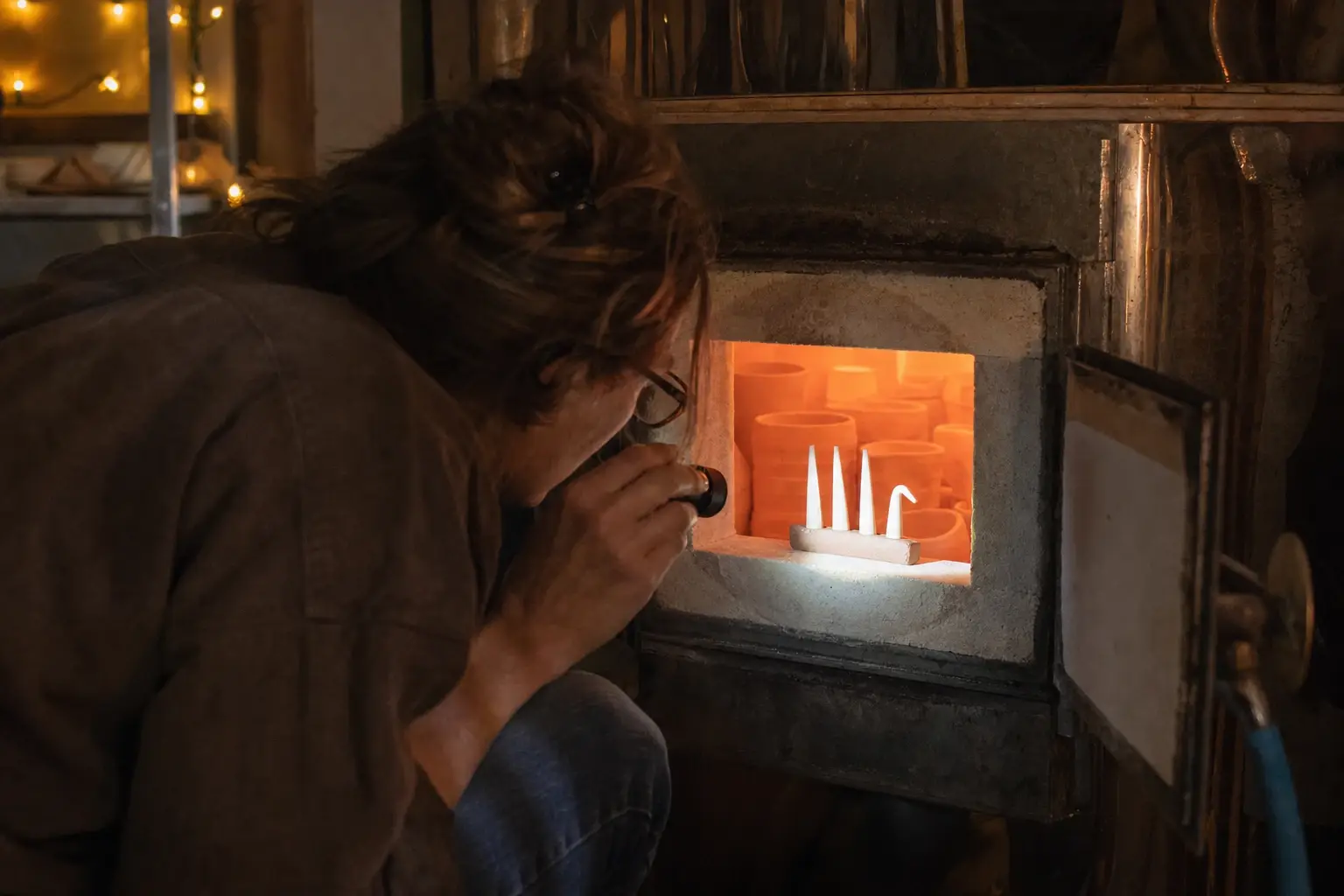
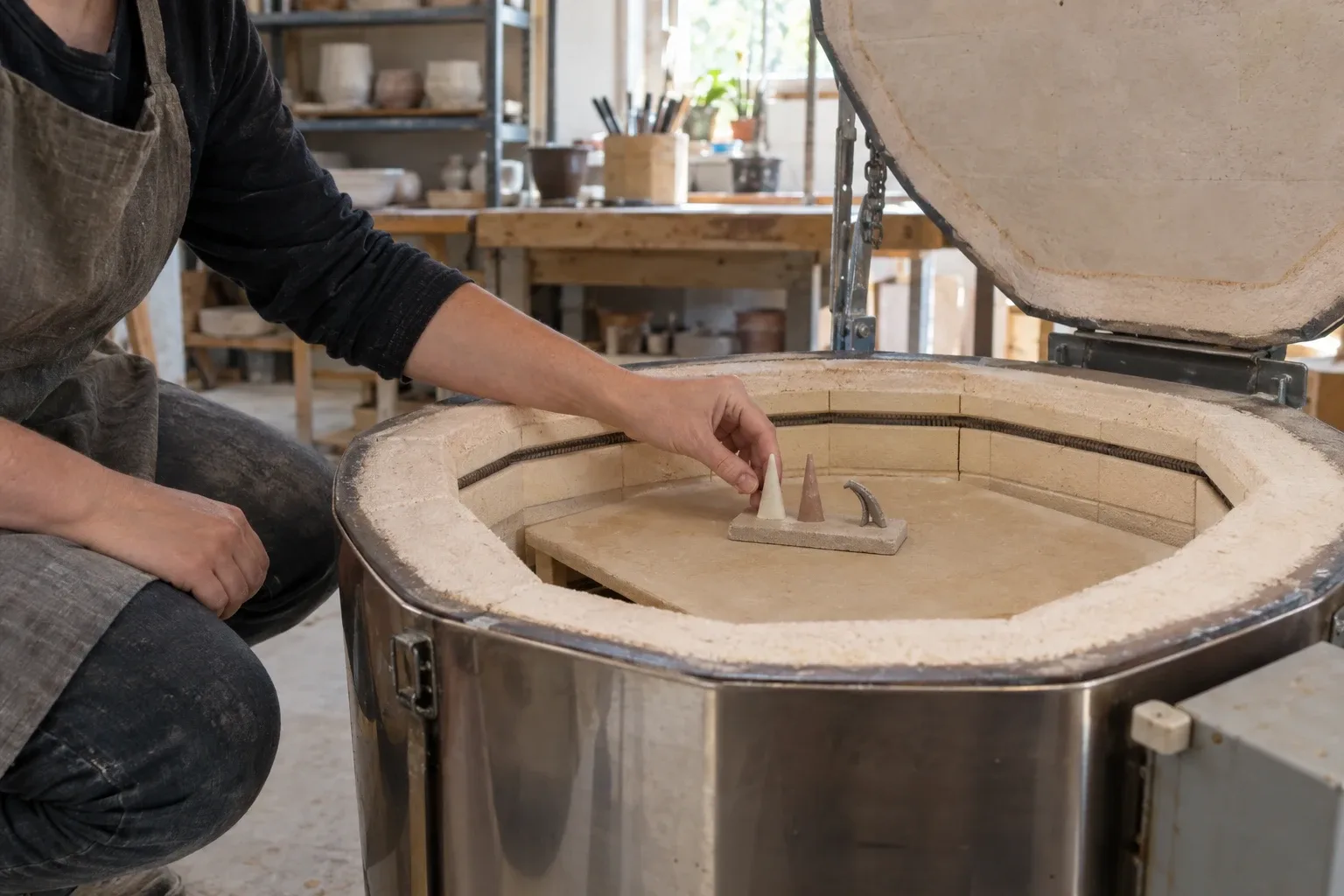
Place witness cones on a small clay pad or commercial cone holder, spacing them so each can bend freely. Position the set where you can see it through a peephole without opening the door mid-firing. Use at least three cones: one below your target (the guide cone), one at your target (the firing cone), and one above (the guard cone). When the firing cone bends and its tip nears the shelf, the firing has delivered the intended heat-work.
How Do I Match Cone Numbers to Temperature?
Cone charts list approximate temperatures for standard heating rates, typically 108°F per hour (60°C per hour) in the final climb. A faster ramp requires a higher peak temperature to bend the same cone; a slower ramp bends the cone at a lower reading. Your electric kiln for firing pottery may ramp faster or slower depending on load density, element condition, and weather, so the controller's temperature display is a guide, not a guarantee.
For bisque firing, cone 04 (around 1940°F or 1060°C) suits many earthenware and mid-range clay bodies. For glaze firing, cone 6 (around 2232°F or 1222°C) is common for mid-range stoneware, while cone 10 (around 2381°F or 1305°C) serves high-fire work. Check your clay and glaze labels for their rated cone, then program your kiln to that cone using the controller's cone-fire mode or a manual schedule that brings the kiln to the corresponding temperature range with an appropriate hold.
How to Use Witness Cones in Your Kiln
Set a small clay pad on a shelf near the center of the load, away from elements and walls. Press three cones into the pad at a slight forward lean, matching the angle shown on the cone package. The guide cone should be one number below your target, the firing cone at your target, and the guard cone one number above. For a cone 6 glaze firing, use cones 5, 6, and 7.
During the firing, check the cones through a peephole as the kiln nears temperature. When the guide cone bends, you are close. When the firing cone bends to a 90-degree angle or touches the shelf, the kiln has reached cone 6 heat-work. If the guard cone also bends, the firing went past target. Record what you see and compare it to the controller's reported peak temperature and hold time. Over several firings, this record shows whether your programmed schedule consistently delivers the intended cone.
When Cone Results and Controller Readings Disagree
If the controller reports cone 6 temperature but the witness cone stays upright, the firing did not deliver enough heat-work. Common causes include a ramp that was too fast, a short or skipped hold, or a thermocouple reading high. If the cone bends before the controller reaches target, the ramp may have been too slow, the hold too long, or the thermocouple reading low.
Adjust one variable at a time. Lengthen the hold at peak by 15 minutes, or slow the final ramp by 50°F per hour, then fire another test with witness cones. If results remain inconsistent, check thermocouple placement and condition, inspect elements for wear, and confirm that kiln furniture is not blocking airflow. A consistent mismatch suggests the thermocouple needs replacement or recalibration.
Cone Packs vs Single Cones
Self-supporting cone packs combine three cones in a metal or ceramic holder, making setup faster and eliminating the need for a clay pad. They work well for routine firings where you trust the process. Single cones pressed into clay give you more flexibility in placement and let you position witness cones at different shelf heights to check temperature variation within the chamber.
For a first firing in a new kiln or after element replacement, use at least two sets of single cones: one on a lower shelf and one on an upper shelf. If one set bends earlier, the kiln may have a hot spot or uneven heat distribution that requires adjusting shelf placement or load density.
FAQ
What cone should I use for bisque firing? Cone 04 (around 1940°F or 1060°C) works for most earthenware and mid-range clay bodies. Check your clay label and follow a bisque firing schedule that includes a slow initial ramp to let moisture escape.
Can I reuse pyrometric cones? No. Once a cone bends, its ceramic structure has changed and it will not provide an accurate reading in a second firing. Treat each cone as single-use.
Why did my cone bend at a lower temperature than the chart shows? A slow ramp or long hold delivers more total heat-work, causing the cone to bend at a lower peak temperature. Cone charts assume a standard heating rate, typically 108°F per hour in the final segment.
Do I need witness cones if my kiln has a digital controller? Yes, especially when learning your kiln or testing a new clay or glaze. The controller measures temperature at the thermocouple location; witness cones confirm heat-work at the ware itself.
How many cones should I use per firing? Three is standard: one below target, one at target, and one above. For thorough verification, place a second set on a different shelf to check for hot spots.
Keep this nearby while you make, then let the next piece be your own.