TL;DR
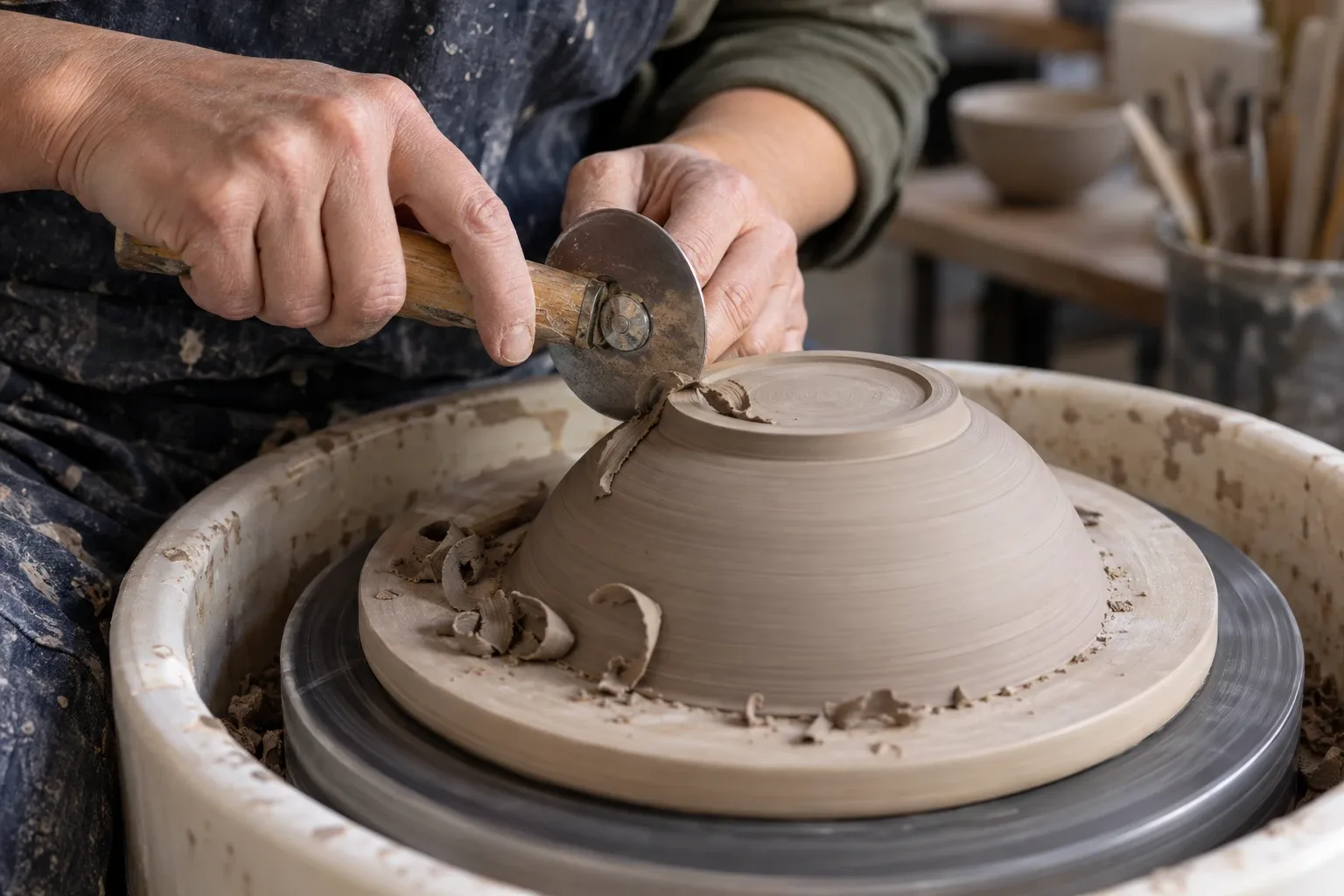
A pottery trimming disc is a trimming tool with a round or rounded cutting edge that removes clay across a broad, controlled area. Choose one when you want to shape a shallow foot ring or smooth a trimmed base without the narrow grooves a pointed loop can leave.
For most beginners, one medium disc-shaped tool plus a narrower loop tool is more useful than buying a full matching set. The pot must be leather hard enough to hold its shape, centered securely, and supported before you begin.
What is a pottery trimming disc?
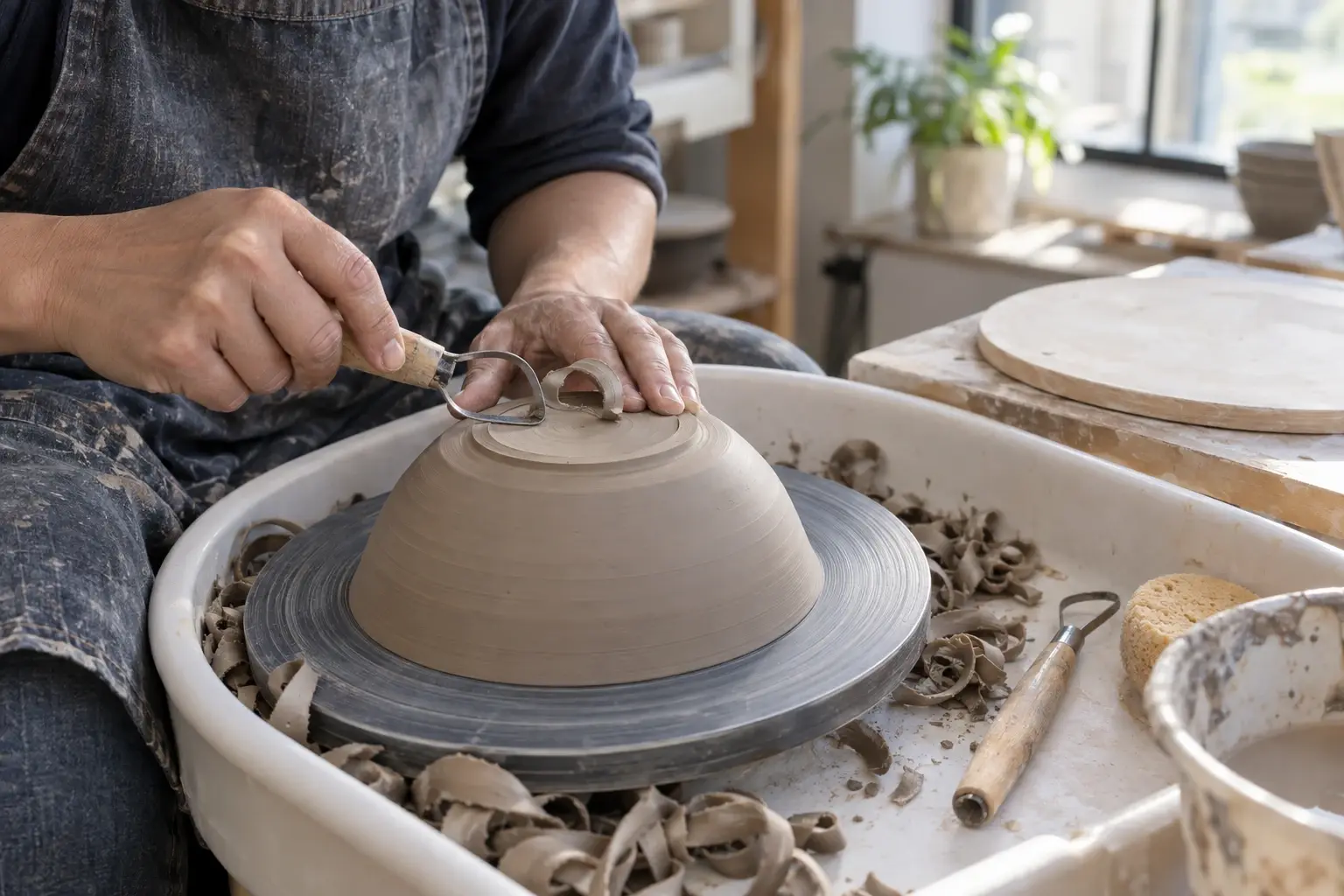
A pottery trimming disc is generally a handheld trimming tool whose working end has a circular, oval, or gently curved profile. As the pot turns, the edge shaves away thin layers of leather-hard clay. The broad contact area can make it easier to create a smooth transition from the foot ring into the base.
The name is not perfectly standardized. Before purchasing, inspect the product photos and description for the actual edge shape. Some disc tools are nearly circular, while others have a flattened or curved edge that is better suited to a particular foot profile.
A disc is not the same as a trimming bat or turntable. A bat holds the pot on the wheelhead, while a hand-powered pottery trimming turntable helps you rotate and inspect a piece off the wheel.
When does a disc work better than a loop tool?
Use a trimming disc when the main job is smoothing and shaping a broad area. A narrow loop or ribbon tool is usually more efficient for cutting a clear trench around a foot or removing clay from a tight recess.
| Trimming task | Better first choice | Why | |---|---|---| | Establishing the outer edge of a foot ring | Narrow loop tool | Defines a precise boundary | | Removing clay from a broad base | Trimming disc | Takes controlled, shallow passes over more surface | | Refining a soft curve into the foot | Trimming disc | Helps avoid a series of narrow channels | | Trimming a small recessed foot | Small loop tool | Reaches confined spaces more easily | | Cleaning a sharp corner | Small pointed tool | Offers more exact placement |
A disc does not replace every other trimming tool. Build a compact set around the forms you actually make, then compare edge shapes and handle comfort with this guide to pottery trimming tools.
Choose the disc by your foot-ring profile
Start with the diameter and depth of your usual pots. A wide, low bowl often benefits from a broader disc, while a small cup or narrow vessel calls for a smaller edge that can work close to the foot without touching the wall.
Check these details before choosing:
- Edge profile: A rounded edge supports soft transitions. A flatter edge can help level a broad base.
- Tool size: The working edge should fit the area you need to trim, not merely look substantial in a product photo.
- Handle and shaft: Hold the tool as you would while bracing your hands on the wheel. A secure grip matters more than decorative handle material.
- Edge material: Steel and carbide tools can feel different in use and maintenance. If you work with clay bodies that wear edges quickly, compare the trade-offs in tungsten carbide pottery trimming tools.
- Your existing tools: Avoid buying a disc that duplicates a loop shape you already reach for successfully.
Use a pottery trimming disc for a stable foot ring
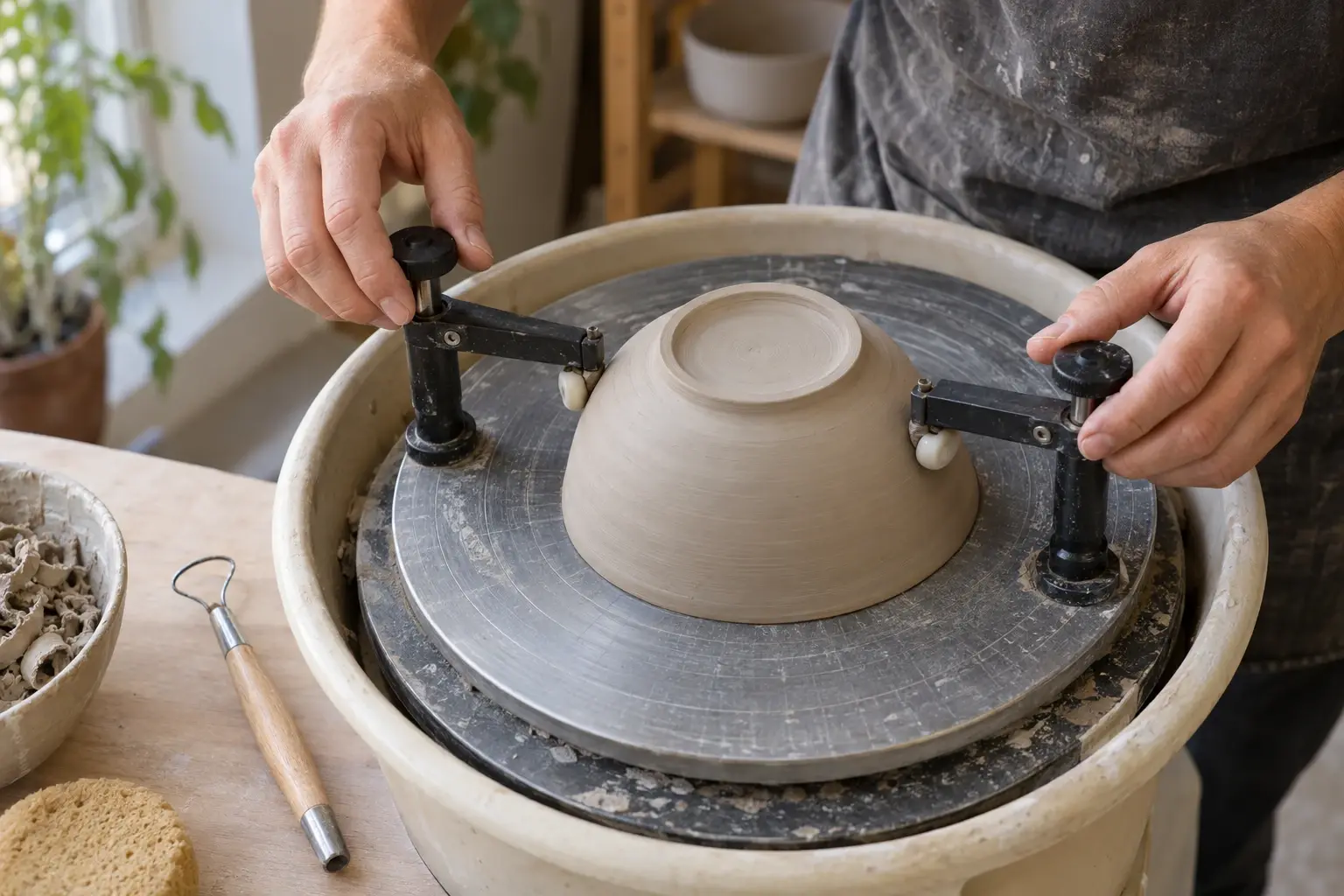
Secure the pot upside down on a clean, flat bat. Center it carefully, then rotate the wheel slowly enough that you can see any wobble before cutting. If the form needs extra support, a pottery trimming chuck can steady a bowl, tall form, or uneven rim.
Make a light guide cut to mark the outer diameter of the foot. Then brace both hands and present the disc edge gradually to the clay. Let the turning pot meet the edge rather than pushing the tool aggressively into the base.
Use several shallow passes instead of trying to complete the foot in one cut. Pause between passes to check three things: the base is still thick enough, the foot ring is even, and the pot remains firmly attached. Finish by softening the transition just outside the foot, then clean loose crumbs with a soft brush.
A simple disc-tool comparison test
Trim two similar practice cylinders at the same leather-hard stage. Use your usual loop tool on one base and a disc on the other. Keep wheel speed, attachment method, and target foot size as consistent as possible.
Afterward, compare the bases for visible grooves, evenness of the foot ring, ease of control, and how much cleanup each surface needs. Record which tool gave you the result you want with the fewest corrective cuts. That observation is more useful than choosing by tool shape alone.
Keep this nearby while you make, then let the next piece be your own.