TL;DR
A foam bat for trimming pottery can help support leather-hard bowls, cups, and uneven forms without pressing them directly against a hard surface. Choose one by checking its firmness, flatness, surface grip, thickness, and cleaning routine, then test it with the forms you trim most often.
What is a foam bat for trimming pottery?
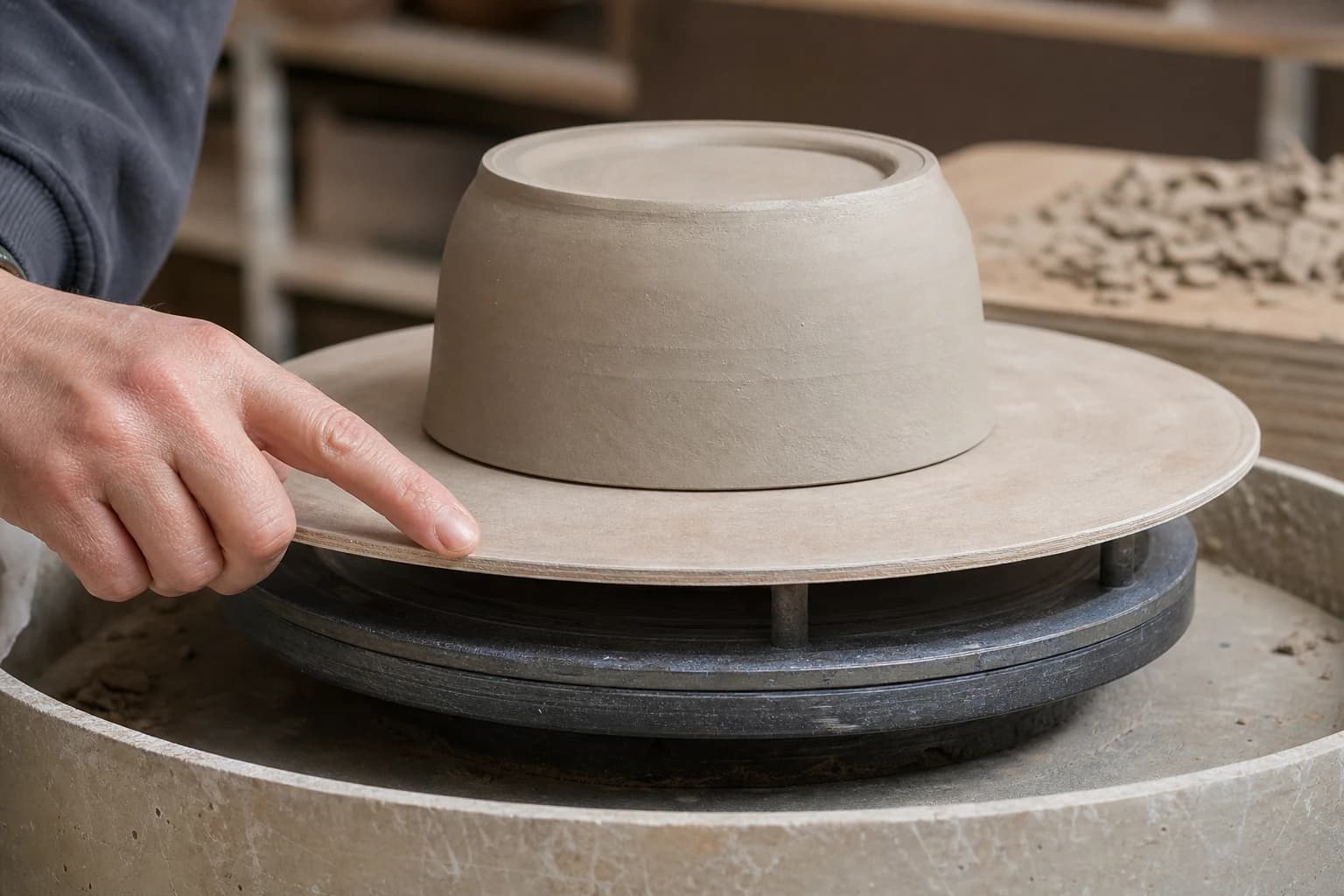
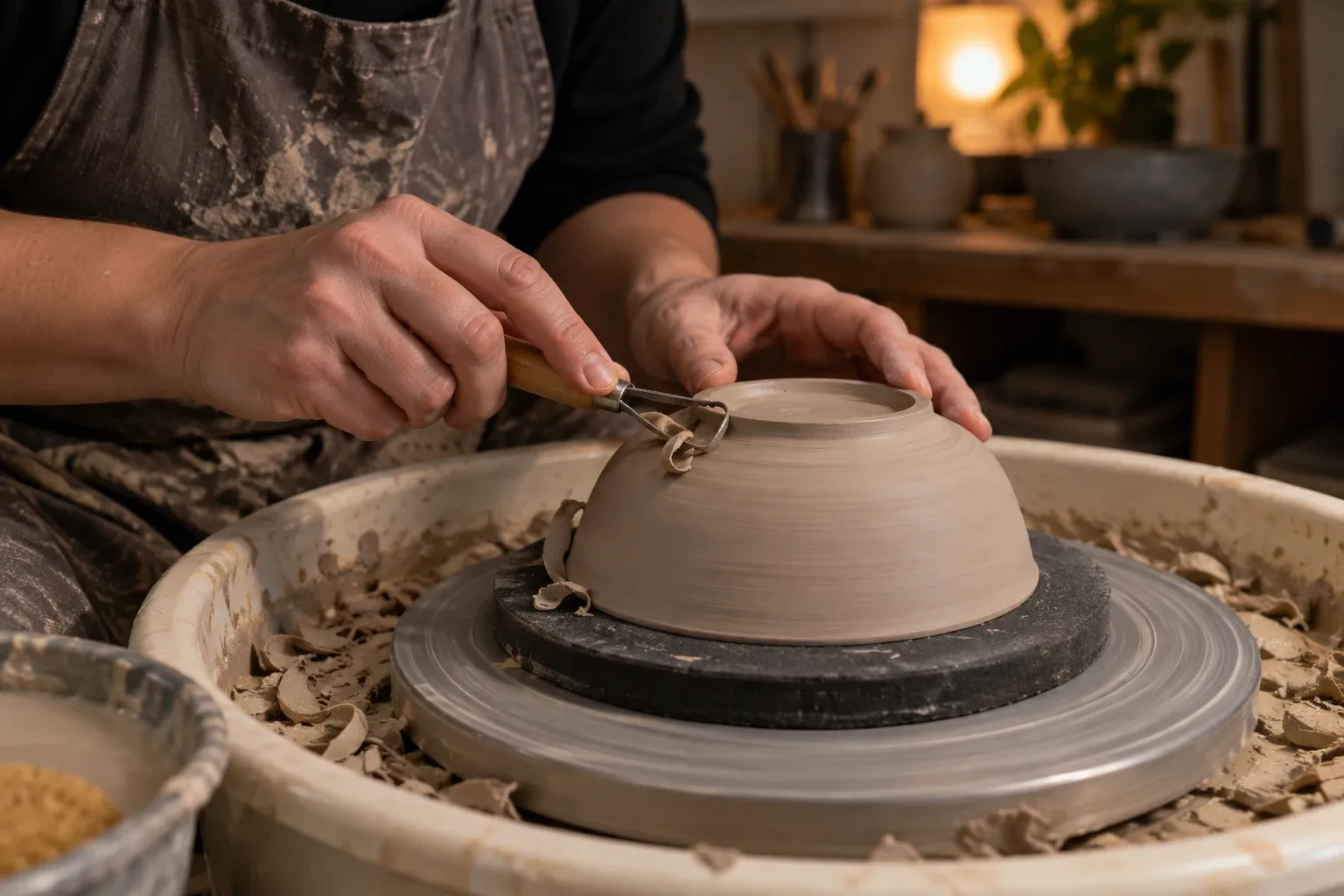
A foam trimming bat is a removable support with a foam surface or foam construction that holds a pot during trimming. Instead of relying only on friction from the wheelhead or a rigid bat, the foam provides a softer contact point around the vessel.
That contact can be useful when the rim or walls are slightly delicate, when the form is not perfectly symmetrical, or when you want to avoid pressing hard while securing a piece. The bat does not replace careful centering or appropriate clay stiffness. It is a support tool, not a way to make a soft or unstable pot ready for trimming.
Foam bats vary in firmness and surface texture. A softer surface may accommodate small irregularities, while a firmer surface can feel more stable under a trimming tool. The right balance depends on the shape, weight, and leather-hard condition of your work.
When should you use a foam trimming bat?
A foam bat is worth considering when your usual support creates one of these problems:
- A bowl rim rocks or flexes when you secure the piece.
- A narrow vessel is difficult to hold without marking its walls.
- A leather-hard form has a slightly uneven profile.
- You trim several similar forms and want a repeatable support setup.
- A rigid bat transfers too much pressure to a fragile rim or foot.
For broad, stable cylinders, a standard bat may be faster. For deep bowls or narrow-necked forms, a pottery trimming chuck may provide better support because it holds the inside or outside profile more deliberately. A pottery trimming disc may be a better choice when your main need is a firm, open surface for broad foot rings.
Use the foam bat when it solves a particular handling problem. Do not buy one simply because a softer surface sounds more forgiving.
What should you look for when choosing one?
Firmness and recovery
Press the foam lightly with a finger, then watch how quickly it returns to shape. You want enough give to protect a form from harsh contact, but not so much movement that the pot shifts while the trimming tool meets the clay.
If you shop in person, compare two or three areas of the surface. Uneven softness can make one side of a pot sit higher than the other. For online shopping, look for clear information about the foam type, firmness, dimensions, and attachment method rather than relying on a product photo.
Flatness and thickness
Place the bat on a known-flat surface and check whether it rocks. A bat that is not flat can transfer wobble to the pot before trimming begins. Thickness also affects how much clearance you have around the wheelhead and how easily you can reach the foot.
Measure the space available on your wheel before ordering. Include the bat’s attachment hardware or base if the product uses one. A large support may suit wide bowls but leave less room for your hands, splash pan, or trimming tools.
Grip and surface behavior
The surface should hold the pot without requiring excessive pressure. Too little grip allows slipping. Too much grip can make repositioning awkward or pull at a soft contact area.
Check whether the surface is smooth, textured, removable, or washable. Clay slurry can collect in foam, seams, and attachment points. A design that is easy to wipe and inspect is usually easier to keep in your regular workflow.
Attachment and compatibility
Confirm how the bat connects to your wheel. Some setups use pins, a fixed base, or another attachment method. Match the system to your wheelhead and existing bats rather than assuming every trimming bat is interchangeable.
For a broader tool comparison, see this guide to pottery wheel trimming tools. It can help you decide whether the support is the missing part of your process or whether a different trimming tool would solve the problem more directly.
How do you use a foam bat for trimming?
Start with a leather-hard piece that can support its own shape. Clean the bat and wheel area, attach the bat according to its design, and check that it sits securely before placing the pot.
Center the piece as accurately as you can. Use light, even pressure to hold it in place. If the form rocks, stop and correct the support instead of compensating with stronger pressure. Strong pressure can distort a rim, compress a wall, or shift the pot off center.
Turn the wheel slowly enough to observe the movement. Watch the rim and outer wall first, then make a shallow trimming pass. If the form shifts, stop, inspect the contact area for clay or moisture, and reset it. Keep the first pass conservative so you can confirm that the foam is supporting the piece evenly.
After trimming, remove clay from the bat before it dries into the surface. Follow the material’s care instructions, especially if the foam should not be soaked or scrubbed aggressively. Store it flat and away from tools that could cut or permanently compress it.
A five-minute test before you buy
Use this repeatable test with a foam bat in a class, store, or borrowed setup:
1. Place the bat on the wheel and check for rocking. 2. Set an empty leather-hard form on it and apply only light holding pressure. 3. Turn the wheel by hand and watch for side-to-side movement. 4. Make a shallow trimming pass on a test piece. 5. Remove the piece and check for pressure marks, slipping, or uneven support.
Record the form type, clay stiffness, bat firmness, and result. Repeat the test with a bowl and a straight-sided cylinder if those are both part of your work. Choose the bat that reduces a real problem without creating a new one.
A foam bat is most useful when it fits your existing trimming routine: stable attachment, predictable support, manageable cleanup, and enough firmness for controlled cuts. If your main issue is centering an irregular pot, compare it with a pottery trimming centering tool before making a purchase.
Keep this nearby while you make, then let the next piece be your own.